
The Digital Control Stack
This is lengthy, because the system they're building is too...

You don’t really think it’s scrapped, do you?
You honestly believe the globalists just shrugged, sighed, and abandoned a decades-old plan because Keir Starmer stood at a podium and said the magic word?
Please tell me you don’t actually trust what he’s saying… right?
“Scrapped.”
Oh, please.
This is the plan.
It starts up here, with this graph: WEF rhetoric for the vision, UN for the moral perfume. Then it’s filtered down through “consultations” with Big Tech, financiers, and the friendly pilot-runners at ID2020, before being quietly handed to our government like a finished script.
Then comes the policy laundering.
Documents carefully written to make it look like a homegrown solution. A British idea. A sensible response to immigration. A practical modern upgrade.
And the sales pitch?
So you don’t have to rummage through a drawer looking for a utility bill.
Imagine how wonderful it will be… to never have to rummage through a drawer ever again.
No more scrambling for paperwork. No more proof of address. No more “sorry, we can’t verify you.”
Because instead you’ll be:
Geofenced inside your 15-minute city.
Tracked in your online activities.
Forced to prove you are who you are for access to anything; services, travel, banking, purchases, even basic participation in society.
Your money will be programmable.
Your permissions will be conditional.
Your identity will be a switch someone else controls.
But hey… at least you won’t have to rummage through a damn drawer.
So, back to basics we go.
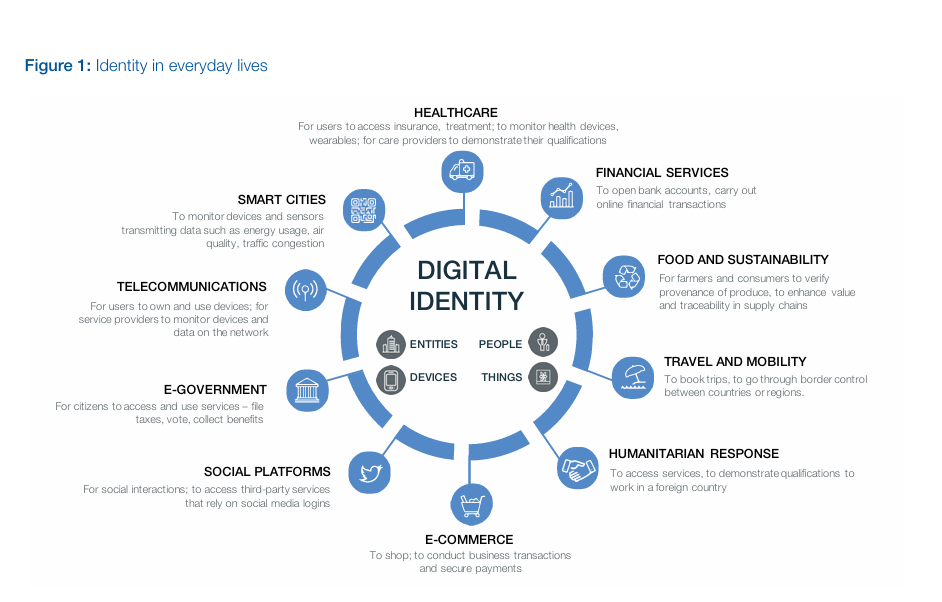
That circle diagram?
It isn’t a neutral picture.
It isn’t “just a concept map.”
It isn’t a harmless infographic.
It’s a strategy map.
On page 10 of the WEF Insight Report 2018, you’ll find it laid out in polite corporate language: a future of Digital control disguised as convenience.
And the part people miss is simple:
The designers expect Digital ID to plug into every part of everyday life.
Read it literally.
Because they wrote it literally.
The centre is the key: DIGITAL ID
Not “an ID card.”
Not “a right to work check.”
Not a single credential.
The plan for the UK (each state will have their own ‘branding’):
DIGITAL ID = OneLogin account + UK Gov Wallet
A wallet designed to host multiple credentials and tokens.
And that’s the point.
The now-abandoned “BritCard” right to work/rent credential was never the whole thing.
It was one token.
Just one small element of a single spoke.
A test run.
A red herring.
Let’s clarify the trap:
Right to work and right to rent checks REMAIN MANDATORY by 2029 (will be much sooner) via OneLogin.
And there will be another token for RTW/RTR.
It will slip back in.
Quietly.
With new branding.
With new “safeguards.”
With the same function.
The diagram: what it literally shows
Centre: DIGITAL ID (Entities, People, Devices, Things):
This is the part that should make your stomach drop.
Identity isn’t just for humans.
It’s for:
people
organisations
devices
machines
goods
“things” on the supply chain
In other words:
Everything gets tagged.
Everything gets verified.
Everything gets logged.
The spokes: where they expect Digital ID to be used:
Healthcare.
Financial services.
Food and sustainability.
Travel and mobility.
Humanitarian response.
E-commerce.
Social platforms.
E-government.
Telecommunications.
Smart cities.
Each spoke is a sector where they expect the same identity system to be accepted.
Not “optionally.”
Not “in some cases.”
As infrastructure.
What each spoke means in practice:
Healthcare:
Digital ID to access insurance, link wearables and medical devices, and let providers “prove qualifications” while accessing patient records.
Translation:
Your medical history becomes a persistent digital key tied to you forever.
Financial services:
Open accounts, authorise transactions, automate KYC.
Translation:
Your ability to use money or credit becomes dependent on a credential check — tracked, logged, and tied into a permanent audit trail.
Food and sustainability:
Provenance tracking. Supply chain credentials. Consumer records.
Translation:
What you buy becomes traceable.
And carbon score?
Score exceeded = no meat, no travel, no energy.
Travel and mobility:
Booking, border control, cross-border checks.
Translation:
Not just international travel.
Local travel too.
15-minute cities
Facial recognition.
Geofencing.
Biometric gates.
Passports on a ledger.
Tied to carbon permissions.
Humanitarian response:
Aid distribution. Work authorisations. Recognised credentials.
Translation:
No Digital ID?
No assistance.
No recognised credential?
No humanitarian aid.
E-commerce:
Payments. Shopping. Identity for buyers and sellers.
Translation:
Commerce becomes credential-based, not cash-based.
And when money becomes programmable?
Then purchases become permissioned.
Social platforms:
Single sign-on. Third-party services tied to one identity.
Translation:
Your online activity becomes tied to your offline permissions.
What you do online becomes your social credit file.
And punishment becomes frictionless.
E-government:
Taxes, voting, benefits, passports, licences, company directorships.
Translation:
The entire state service stack plugs into the same ID.
Everything civic becomes conditional.
Telecommunications:
SIM registration. Device ownership. Network monitoring.
Translation:
Your phone becomes another identity anchor.
Your internet use becomes surveilled, tracked, and logged.
Smart cities:
Sensors, energy systems, transport, congestion systems, facial recognition.
Translation:
The smart/15 minute city becomes a machine that recognises you, logs you, and profiles you from the moment you wake up.
“Personalised services” is the marketing term.
Control is the function.
Key ugly truths the graphic reveals:
1) One wallet, countless gates
This isn’t a system designed for one purpose.
It’s designed for universal re-use.
Once it exists, it becomes the obvious route for everything.
2) Not just people, “things” too
By including devices and things, it foreshadows the Internet of Identity:
Your devices.
Your appliances.
Your transport.
The infrastructure around you.
All identifiable.
All trackable.
3) Interoperability = scale of control
The entire purpose is interoperability.
Meaning:
Public systems and private systems can all accept the same credential and share the information with each other.
And public and private bodies share and log the same data, about YOU.
4) Audit trails baked in
Every verification becomes a logged event:
Who checked you.
When.
Where.
Why.
Normal life becomes an auditable history.
5) Mission creep is not a bug, it’s the plan
They map the full universe of uses because they expect the spread.
From:
“right to work”
to:
mortgages
benefits
pensions
school places
healthcare
travel
employment
payments
energy
All via the wallet.
6) Infrastructure before consent
The sequence is always the same:
Build the stack.
Normalise the use.
Then argue about safeguards later.
By then, consent is not requested, it is coerced through exclusion.
7) Vendor and state capture
Whoever controls the wallet, registries, APIs, and certification becomes the gatekeeper.
Public-private delivery doesn’t reduce power.
It embeds private firms as civic infrastructure.
And the worst part?
If you don’t comply with directives…
nudges…
orders…
restrictions…
Or if you say something they don’t like on social media?
They can switch you OFF.
No wallet.
No access.
No purchases.
No travel.
No participation.
This graphic is their plan:
To make one digital ID the universal key that opens (or closes) access to every part of life.
In a nutshell:
The UK Gov Wallet is the all-encompassing Digital ID.
The people tracking super cookie.
The wallet will host multiple tokens including the right to work and right to rent credential.
It has not been scrapped.
And to have that wallet, you will be forced to use OneLogin which will host your biometrics.
OneLogin Account + UK Gov Wallet = Digital ID.
Keep talking about this; they distract the masses while they build the system:
MassNonCompliance.Com
Thank you for this information, Fiona. It's really scary, isn't it.
Fabulous read this and you said it was going to a long one lol
To be honest I’ve said it so many times the system is already set up ready to roll out they’re just doing it slowly so no one notices it and it will seamlessly creep into daily life without anyone paying much attention
Tye biggest question is when not if this comes into effect how do those who don’t wish to be a part of that new world live out normal daily lives?
This is the biggest issue I see right now and although it may sound negative of me to say I know this will come into being at some point soon so maybe it might be an idea to start planning ahead of the game and be one step in front when it does become a thing in our lives.
I’ve lived long enough to know that the government don’t ask for your permission on any issues and democracy doesn’t exist in real terms because they make the rules and implement those rules regardless of public opinion and that’s an absolute fact..
Sooooo how do we construct an alternative way of living outside the system?
I know many people who will not wish to live in this new system but I also know many more who’ll just fall straight into the trap of “convenience” because they trust too much and it will be quite interesting to see how this actually pans out in realtime